The Atlantic Waves project is an improvisational mixed media performance or interactive installation, based on a self written network sequencing application. The original idea was to find a simple way for me to perform shows together with Deadbeat using network technology. Scott Monteith (Deadbeat) and me came up with it during a coffee break at the NAMM show 2001.
The first performance happened at the MUTEK festival Montreal in 2002 between me in Berlin and Scott on stage in Montreal. From the very beginning the project also had a strong visual component since the interface is projected for the audience to follow the actions of the two participants. In more recent versions of the software the visual part became more and more an artwork in itself and the interaction between sound and image became much more complex.
Derived from the Atlantic Waves project is the Linear Grid network installation, presented spring 2007 at MUDAM & Philharomie Luxembourg.
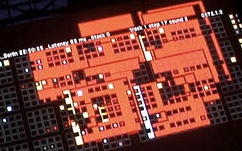
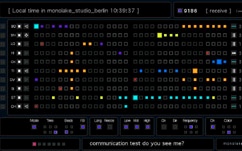
The heart of Atlantic Waves is a step sequencer, a large matrix acting as the score which can be created and modified in real time by both participants. This sequencer allows to draw notes into a grid on screen, visible for the audience as well as for the performer. The grid is a matrix of 15 rows and 32 columns, providing 15 independent instrument tracks. Each row can be activated and controlled independently. If a track is active, a red dot is moving thru it horizontally. Each time this red dot hits a colored square set by one of the performers, a sound is created by the audio engine. This allows to create rhythmical patterns by drawing. Each performer has its own color, making it possible for the audience to follow who is doing what. The movement of the red scanning dot can be quite complex; each track can have its own direction, offset, speed and length, providing a simple but very effective way to create constantly permutating musical structures [sound example, created 02/08/2007].
In the first incarnations of Atlantic Wave the sound was composed of short percussive samples, created mostly by Scott Monteith. In the most recent version the samples have been replaced by real time synthesis, providing more access to all parameters of the sound. While the sound design of the older versions was still very much modeled after acoustic or known electronic sounds, the latest versions provide a more abstract sonic quality which matches better with the more abstract visualisation.
Since Atlantic Waves V the construction and deconstruction of the image is an essential part of the performance. At the beginning the visual structure of the sequencer is created. The creation process itself is linked to sound generation and can also be controlled by both performers. Later the structure is populated by elements in order to create the complex rhythmical movements. In a third step the interface is deconstructed while in use, and this has also a significant impact on the sound generation. These three parts of the performance can be repeated or interleaved since they are all part of the same process. This makes Atlantic Waves a complex and powerful playground for audiovisual interactions.
Atlantic Waves is based on a very large MAX/MSP patch. All audio, networking and visual interaction is done within this patch. The patch also contains a chat feature, embedded in the graphical interface. This allows the audience to follow also the chat between the performers. The audience always sees exactly the same information as the performers. The software does not transmit any audio or video signals thru the network but just control data. The music and image is created in both locations simultaneously, synced and controlled by the commands of the performers. Providing a relay server in the future will make it possible to extend the number of performers, allowing three or more people to interact. This is planned for version six of Atlantic Waves.
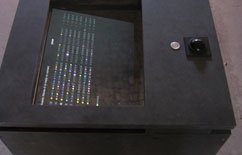
The straightforward interaction concept of Atlantic Waves makes it possible to derive an interactive sound installation from it. This has been done in Berlin at the parachial church in 2004, curated by Carsten Seiffart. Two terminals were build, housing the computer, a TFT screen and the soundcard. One terminal was located in a bigger room in the lower part of the bell tower, one terminal at the top in the small room below the bells. Visitors could play with each others on these two terminals. The installation version features a special idle mode. If no visitor is actively contributing anything it starts permutating the exising structure by itself, finally leading to a pleasant but interesting background. As soon as someone starts setting or deleting steps the idle mode stops and the visitor is in control again.
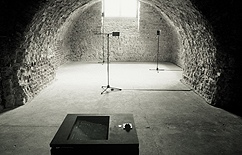
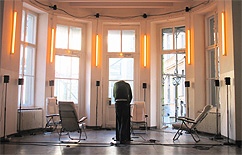
For an installation connecting a room at the MUDAM Luxembourg and the foyer of the Philharmonie in Luxembourg a multichannel audio version has been developped, based on Atlantic Waves V minus the visual deconstruction. Eight speakers are placed in front of the terminal in a row, representing the geometry of each track. The sound is traveling thru these speakers, just as the red dots travels thru the step sequencer. The result is an even closer connection between the audio signal and the visual score.
Here is a dedicated page for this project.